Modern spirituality often glorifies transcendence—rising above the body and the world. But what if that’s only half the path?
In this illuminating conversation, Cynthia Abulafia—author of Embodying the Goddess—challenges patriarchal spirituality and calls us back to sacred embodiment. Drawing from non-duality and Tantric traditions, she reveals the Divine Feminine as alive in the body, the breath, and the Earth.
You’ll explore:
- The Divine Feminine beyond gender—rooted in vibration and embodiment
- The hidden cost of “leaving the body” (the Transcendence Hangover)
- The true, fierce compassion of Kali
- A simple breath-based mantra to reconnect with the sacred
This isn’t about escape—it’s about integration. Divinity lives here, in your body and this Earth.
—
Listen to the podcast here
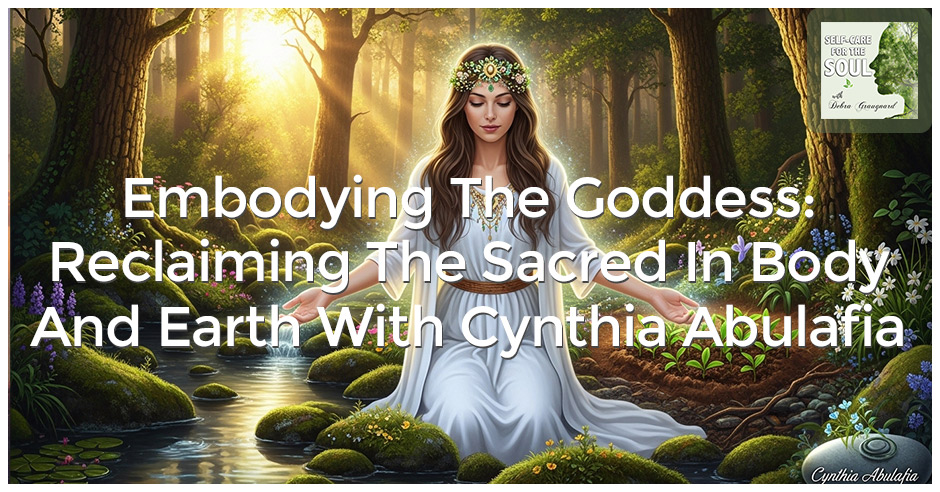
Embodying The Goddess: Reclaiming The Sacred In Body And Earth With Cynthia Abulafia
Welcome to the show. I have with me Cynthia Abulafia. Welcome, Cynthia.
Thank you so much. It is nice to talk to you, Debra.
I am excited for our conversation. I want to begin by reading Cynthia’s bio. Cynthia Abulafia is an author, educator, and yoga therapist committed to giving language to the divine feminine and restoring the experience of embodiment as the heart of spiritual practice. We are cut from the same cloth.
A long-time student and teacher of non-duality, she guides people through Kundalini awakenings and spiritual crises with grounded tools rooted in embodiment, breath, and the context of sacred texts and traditions. Her debut book, Embodying the Goddess, challenges the transcendence bias of patriarchal spirituality and offers a path of radical integration. Cynthia, I am very excited for this conversation. I usually start by asking people, how did you get here?
When studying the goddess traditions, there is a lot that has to come in for us to get there because it is not handed to us. It is not part of a cultural dialogue. Maybe nowadays it is happening a little bit more, but I think the most honest answer is a series of trippings and fallings, maybe. Like a series of understandings that yielded more confusion than answers. After that happens for a certain amount of time, I think that at some point this divine feminine principle starts to come in, and then it upends everything we knew previously. It upends the entire spiritual model that we thought, at least I thought I was pretty well-versed in. I realized, “I have to start from the beginning.”
Challenging The Transcendence Bias & Radical Integration
That is a powerful awakening and also takes a lot of courage to let go and go back to that beginning point. I have got to jump into this last sentence on your bio, which challenges the transcendence bias of patriarchal spirituality and offers a path of radical integration. Can you explain what you mean by that and how you approach it?
Therein is the feminine. The transcendence bias essentially is the religious model based on history. You can trace it very precisely based on history that says, “Everything is impermanent, only stillness is real. Let it go, move up and beyond, transcend.” Essentially, it is connected to death and dying practices, very tied into Buddhism, Jainism, yoga, and those innovations started about in the middle of the first millennium BCE, so about maybe in the 600s BCE, although the history there does start a little sooner than that.
That is where this transcendence bias really starts to take hold. It is really in that time and place and the traditions born of these teachings where, little by little, the honoring of the body, the honoring of the earth, the relationship between sacred embodiment and tending to sacred earth starts to get more aggressively subordinated and then eliminated altogether.
Therein lies the struggle, that message of “In order to become spiritually aligned, spiritually connected, you have to leave the body.”
You have to leave the body. You have to be saved from it.
Somehow the body is impure, is unholy, is not sacred. When we were talking in our preliminary discussion, you talked about how, as the divine feminine, what has been out in the mainstream, as mainstream as it gets, the conversation around divine feminine, as it is being introduced, there is still a patriarchal overlay, or it is being pasted on through the patriarchal lens.
The structure of the goddess is being directly lifted from patriarchal theory and terms.
That is one of the things that I think has struck me as most of the voices, most of the most popular voices in the self-help personal development world are male voices. Occasionally, one of them will talk about the feminine, but they do not. It is very rare to find one who has actually lived it and really can embody it. I will throw that question out for you, do you believe it is possible for someone who lives in a male body to fully embody the sacred feminine?
Divine Feminine Vs. Female & The Role Of Sound Vibration
All embodiment is the sacred feminine, whatever body you happen to be in, whether that body is male sexed, female sexed, sexed entirely different from male or female designation, whether you are a tree, a rock. Embodiment pulsation form is the divine feminine. Clearing up the problem between, and this is a language problem, but clearing up female from divine feminine is extremely important to do. I still use the term divine feminine, and I am an advocate for that term.
I am also an advocate for understanding and reconciling the female spiritual experience in a female sexed body. I do think that there is a historical precedent to do that, to connect the divine feminine with females specifically, the priestess, the form of the goddess, but we need to understand that that is the last evolution of the conversation. Having a female form for the goddess herself is not even where she starts. She starts in a simple embodiment.
In fact, she starts with sound vibration. A lot of times, you have the sacred feminine connected to voice. In some traditions, voice becomes wisdom. It becomes poetry, music, art, but pulsation. Breath becomes empowered with sound, and sound, the word is the original output of the divine feminine. Even in patriarchal religion, when God creates, God creates through what? Through the word. God spoke. The word was, and the word was, and then light came after.
The model goes very far back, but guess what that word used to be a she in most religions and traditions, and then pretty soon it became dominated by a he. I do think that there is a reason to be talking about gender and sexuality in certain cases. My greatest wish is that someday we do not have to do that, that there is enough understanding of these topics and enough understanding of just history that we can now talk about sacred embodiment without having to give it a designation of male or female. Men are in a form, are they not?
Men have body and that body pulsates, and men have lives, and they have creative projects, and they have families, and they have things that they’re teaching. When it comes to who has been injured by the transcendence bias, who has been injured by the patriarchy of spirituality, it is not just women who have been injured. It is also men. All of humanity is deeply in need of this divine feminine principle, but also in need of honoring the female sex.
Those two things are related, but they’re not the same thing. The sacred feminine has to happen internally. The sacred masculine has to happen internally. I teach non-duality. There is no out there. There is only in here, and the reflection of the in here is the vibrating, living, pulsating heart, which pours itself into reality and recognizes itself and then returns. This idea that gets picked up, that is such a beautiful idea in spirituality, like, “We can try to be political about this, and we can try to fix what is out there, but why would we do that if we cannot fix what is in here?”
It’s because what is inside the sacred marriage, this Hieros Gamos, which is inside of me specifically, who holds the kingdom, who holds the keys to that? Ultimately speaking, we hold the keys to that. It is our work that is sacred, that we are doing in that reconciliation that has to happen on the inside. We carry so much conditioning, and there is so much subtle messaging that it is hard to hear our heart through the noise sometimes.
Designating it like, “This is the side of me that is infinite stillness,” which I call the divine masculine, the ground of being. Here is the side of me that is pulsating into form and reality, expansion, contraction. I call that the divine feminine word, sound vibration. Simple, right? It sound vibration has a wave that goes up, and it goes down, expansion, contraction. You can follow the breath, expansion, and contraction. It is the marriage of that, but we are enacting the marriage of that. The heart is beating, expansion, contraction, pause, ground of being, expansion, contraction. The breath is breathing. It is an internal recognition.
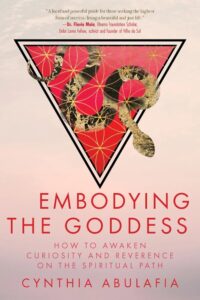
You have a book that you’re releasing this month, Embodying the Goddess. This book draws on the traditions, your primary tradition being yoga, but you’ve also studied, you’re a student of all religions, I understand, or several, many religions, and bringing a number of religions together, also sacred texts. Can you speak to where your influences come from?
I wish I could claim that I have studied all religions. Not all. There are thousands of religions. I would say that I am like a hound for the goddess. When I find a text or tradition that starts to unpack the goddess, especially in her role as the complexity, the ability to hold opposites, the point of transition between life and death, and death and life, like the womb to the tomb. That attracts me. Specifically, I am a religious studies graduate student.
My focus is on tantric non-duality. My greatest love and passion is the medieval period of India, especially northern India and Kashmir. Within those traditions, some of the goddess-based texts and traditions related to Kali or Tripura or goddesses that come out of a usually Shaiva tradition that is Shiva, Shiva Shakti, or Shakti Shiva traditions, but those traditions morph into Tibetan Buddhism, for example.
There is dialogue and exchange with Jainism, there is dialogue and exchange with Vaishnavism for sure, beautiful texts out of the Vaishnava tantras. I study tantra. I am studying Sanskrit currently so that I can look into some of these texts a little more closely with my professor, who is a truly brilliant teacher in these traditions specifically. I feel very lucky to have the teachers that I have. I am also in a tantra lineage with a teacher who is a scholar practitioner of those lineages.
I am lucky on that front as well to be immersed not just in theory, but also in practice and in community, and different forms of community usually related to these goddess traditions. My favorite goddess to study, I am just going to say it straight out, is Kali. She is a very complicated figure to study. I know that nowadays she is rather popular to study, so at least people know her name out there in the spiritual marketplace.
For those who do not, can you say more about who she is, what she represents, and why you’re attracted to her?
For those who do not, who is Kali? Kali is a multitude, actually, of goddesses. She is also represented in certain traditions as the non-dual reality, as the totality, as the godhead, because she is pulsation itself. Kali is a goddess who represents time and the destruction and consumption of time. She has many different forms. In all of her forms, she is a fierce goddess. She does have a nurturing element to her, but it is hard-earned. Typically speaking, when you see images of Kali, she has disheveled hair.
She is breaking with the orthodoxy, the Brahminical orthodoxy of her time period, where the female is ordered. Her hair is wild and unkempt. She is naked, and she has skulls around her neck. Each skull represents what? A syllable in the Sanskrit syllabary. She is wearing the alphabet around her neck, and each one of these skulls represents sound form into creation and into being. She is also carrying different weapons in her hands.
She has a skirt made out of severed human limbs, and she is generally terrifying to behold. She is generally terrifying to look at. However, in these traditions, the visual representation of these goddesses and gods is their least powerful form. For people who really do not understand who she is, they can look at that image and be like, “Fierce goddess, very scary, should pay attention, should propitiate, maybe I should honor her in some way.”
Her form is visual, it is a geometric form, it is the Sri Yantra, which is a series of triangles, but it is also sound pulsation. All deities have a core signature sound vibration, and the sound vibration is their body. That is really who Kali is, but there are dozens of Kalis even in the Krama tradition, which is the tradition that honors her as the ultimate reality. Even there, there are sometimes 12 and sometimes 13 forms of Kali or Kalasankarshini, the one who destroys and consumes time.
She is not a nurturing goddess. She is here to be fierce, as the goddess often is. In fact, if you look at history, the goddess represents warfare frequently. She represents the entry into life through birth, which is not always a pretty process. She therefore also represents death. She represents the things related to children. A mother, for example, can be kind, but can also be really terrifying. She therefore also represents saving a child from illness or making that child sick.
If you look at history, the goddess frequently represents warfare. She also represents entry into life through birth, which is not always a pretty process. Share on XDisease runs through her. If people wanted to propitiate her, it was often to heal them or prevent them from getting sick from disease. She has so many different roles. A lot of those roles do not come out of Orthodox Brahmanism, although she gets appropriated into Orthodox Brahmanism. When you hear of her, you often hear of her as a Hindu goddess, but she really does come out of these tribal peoples. Her history is complex. It is beautiful. It weaves.
Sometimes she represents something, sometimes she represents something entirely different. Whatever it is we can discover about Kali, there is always more that she yields. There is one very important text that describes her called the Jayadratha Yamala. It is this Kali text, a very early Kali text, and probably a primary Kali text. It has not even been translated. There is one scholar that I know who has been working on it for twenty years. It is a very long text.
There are different forms of Kali in the text. The fact that this extremely important primary sacred text that describes this extremely important goddess, people do not even know about it, let alone have read it. Even scholars in the field have a notoriously hard time accessing it. That just goes to show you how hidden some of these goddesses are, even if they have a street name that we have maybe heard before.
It does not mean that they’re well understood or well represented. The question becomes, what does she mean to you? It’s because she comes to people, and I have people reaching out to me all the time. “There is a really terrifying goddessk and her tongue is sticking out.” I already know that. It is how she represents herself symbolically to us in our dreams, in our visions, in our meditations, or in our spiritual process.
Typically speaking, you’re not skipping into the rainbow with Kali. There is a heavy amount of crying with Kali. There is a heavy amount of like, “I went to the hospital because I think I’m going crazy. The intake nurse looked at me, and I swear she turned into the dark goddess in front of my eyes.” She said, “Go home. You will find no help here.” The goddess, when she is in that fierce form, is very particular. She is very particular, very personal.
Sufism, Sacred Sound, & The Feminine Language Of Creation
That is beautiful because when I hear that, I hear the opportunity for radical acceptance. All parts of self are integrated and embodied and lived through one being and not denying or judging or separating or trying to distance yourself or dissociate from parts of yourself, but recognizing the sacredness of all of it.
As you said, that embodiment, that coming together, that integration, that expansion, contraction, pause. I find it really fascinating because that is what you spoke about before. The tradition that I came through is Sufism. I studied with a Sufi master from Jerusalem for twenty years, and he passed away in 2015. I have been on that path for quite some time. I study the step levels of creation, the emanation of creation through sound vibration, as taught by Muhyiddin Ibn Arabi, who lived and wrote in the 1100s and 1200s.
Much of what you’re saying about that sound vibration. There is the alphabet which pulsates, which comes from the beginning of the word. It is breath that moves the air to create the sound, and into the different sound vibrations create the different layers of creation and the different emanations of consciousness.
The Arabic language is said to be a feminine language. A lot of our sacred languages are feminine languages because every sound and every word holds its meaning, its opposite. There is a phrase that says, “A meaning about camels and a meaning about sex,” which means a meaning about our perception of the dense material realm when we are not aware or not connected in the moment with the overarching, the non-duality, the unification of all.
Sex is the unification of parts coming together to create one whole, and to unify in the sacred and in the divinity. All of the meaning of everything is contained within each one of the sounds. As it pulsates, it creates a world within itself and brings the parts together as one. That is the feminine as outlined in that one as well. I hear so much of that in what you’re speaking of.
The Marriage Of Word & Meaning: Breath & Body Integration
The mother tongue. In the Vedas, she’s called Vach. In the Tantras, she has a couple of different names. Malini is one, and Matrika, which is cognate with two English words. Matrika is the goddess of sound vibration. She is the alphabetic goddess. She is sound itself. The two cognates in English are mother, matrika, and matrix.
When you start to hear these terms, and then you understand the layers to them, all of a sudden, sacred sound is powerful, and sound itself is the sacred mirror. Many traditions, in fact, call her by the sacred sound, by the alphabet. These traditions are influencing one another. Sufism has a huge influence on yoga in that exact time period that you’re talking about, and vice versa.
These traditions are like the mystical thrum, the mystical heartbeat that is in agreement in the background as all of the religious orthodoxies in the front. Looking for power, you have these traditions of direct knowledge and pulsation, which have always carried the thrum of the heartbeat and of the word, and they’re there, and we can find them. It is very beautiful. I will also say that there was a very famous poet, perhaps the most famous poet in India, who lived quite early on, I want to say in the 300s, potentially the 400s, named Kalidasa.
One of the most famous things that he wrote was this series of lines. Essentially, it is the marriage of the word and its meaning. His lesson is that you cannot separate a word from its meaning in the same way that you cannot separate God from the goddess. You cannot separate God from the divine feminine, the divine masculine from the divine feminine. Yet we call these two separate things, just like we call word and what that word means two separate things, but you ultimately cannot separate those things.
You cannot separate a word from its meaning any more than you can separate God from the Goddess, or the Divine Masculine from the Divine Feminine. It’s like trying to divide the body from the breath. At a certain point, you realize—they were never… Share on XWhat I would say is it is a great analogy for breath and form for body and breath, because we call the breath something in yoga, and we call the body something. A lot of these sacred technologies, not just yoga, but Qigong, Tai Chi, sacred movement, even sound recitation, mantra. You’re making use of the body in the Sufi tradition. There are many physical practices.
It is like the marriage between the body and the breath. At a certain point, you realize, “Wait a second, they’ve always been married.” The body and the breath cannot be separated. Heat cannot be separated from fire. We call them two separate things. Wherever there is heat, there is fire. Wherever there is fire, there is heat. Wherever there is breath, there is body. Wherever there is a body, there is breath. Calling them two separate things is really like a concession, and then remembering the recognition, recalling that it was one thing to begin with. Now you’re having an experience of the divine directly.
Do you teach this as a part of your yoga practice or your yoga teaching? Do you do teaching, workshops, and also bring people through their experiences?
I do. In teacher trainings, you have to choose. There are so many texts in the wider yoga traditions. I could never say that I understand all of the texts. My professor has something like 20,000 untranslated texts on his computer. Even the ones that we’ve plucked out of history and said, “These are the important texts of yoga,” they are important texts, but these traditions have many important texts to them. I do teach the texts and the thread that I pull, that I try to weave through history, is the thread of breath.
For all of the reasons I just stated to you. When you pull the breath from, let us say, the Nasadiya Sukta for the creation hymn in the Rig Veda, and you start to pull that through the pre-Buddhist Upanishads and then the post-Buddhist Upanishads, you start to create this swelling rhythm in the texts themselves. Sometimes texts can be confusing. Sometimes they can be a little obscure. Sometimes it is like, “I don’t understand what’s going on here.” Sometimes it is dry or boring.
Many times, what you perceive in one moment may be completely different from what you perceive in another moment. That is the beauty of the sacred text to me.
How much do we project on these texts?
In the next moment, the lens may have changed.
From the value system that we carry today. Whereas if you take a time machine and you go back to some of these time periods, if I were to sit and want to study, for example, the Yoga Sutras or the Patanjali Yoga Shastra, which was written in 400 of the Common Era, if I were to take a time machine as a female, non-Brahmin, I would not even have access at all. Here I am sitting in a room of primarily Western people and primarily women, but not always.
Here we are projecting what we want out of this text that is a transcendence text. It is a text to let go of, transcend, and release the mind, and then we show up the next day into our bodies doing sun salutations. It is almost funny because here we’re being told, “Go up and out, be saved from your mind.” Now, where are the traditions that remind us, “Come back in”? They’re there. There is history. What I do is I try to create a more complete picture for people.
Like, “We’re going to go through this phase because it is important. It is important to see what you are not.” The transcendent path is part of religion for a very serious reason because we get very confused, and we think we are our thoughts, and we think we are our emotions, and we think we are our stories. You have to have a direct experience of knowing that you are not those things. This is the path of transcendence.
This is the let it go model of spirituality, and you must go through the let it go path to have a direct experience of wholeness. If we do not complete the circle, if we’re taking this path to the end of what we’re calling the end of the road, but all it is is a point in a circle. If we’re taking this path to what we’re not, you are not your thoughts, you are not your body, you are not your emotions, you’re not your story. Everything is impermanent. Nothing is real. This is all a dream.
If you say this to people, and I’ve sat in non-duality rooms, I followed the direct path of non-duality for fifteen years. For fifteen years, I was listening to teachers say, “You are not this; you are not this.” There are profound experiences when you sit with a teacher who is saying, “You are not this,” especially if they’re transmitting, and many of these teachers are transmitting. You sit with that over and over again.
For me, and this is part of the story, the first question you asked me was, what’s the story that got you into the goddess? There was a certain point sitting again and again. “You are not this.” I was like, “For goodness’ sake, what am I? Can we complete the circle at a certain point? Can we have a conversation here about the pulsation that I am?”
If you do not include the condensation into form and into body, if you do not say, “By the way you also are that, and by the way, Mother Earth is of your body, and by the way, Mother Earth is sacred and worth honoring, and she is the entirety of pulsation and she is the entirety of creation, then what’s going to happen?” In our religions, in our academic institutions, which are basically an offshoot of our religions, in our business ventures, we’re going to start ignoring the body, and we’re going to start ignoring the earth.
If we don’t say, 'You are that—and Mother Earth is your body, sacred and worthy of honor, the very pulse of creation,' then our religions, our academic institutions—so often offshoots of those religions—and even our businesses will begin to ignore the… Share on XThe Transcendence Hangover & The Need For Embodiment
We’re going to start causing injury to the body and to the earth. We’re going to start building. Those buildings are going to go higher and higher away from the skin of the mother, away from the earth. The people that we place at the top of that building are the people that we’re going to look up to the most. They’re also going to be the people who yell at us the most. They’re going to be the people who have to shout from the rooftop and put us into submission.
Meanwhile, down at ground level, where all of the suffering is happening, we no longer are elbowing each other and telling each other our sacred stories because we do not even remember how to do that. The traditions and religions that honor sacred storytelling have been wiped out of our academia, have been wiped out of our religions, and we have forgotten the importance of the cave. From that point at the top of the mountain, from that point at the top of the building where the CEO sits, all that matters is what? Light. Enlightenment. To go up and out into the light.
What happened to the dark? What happened to the cave? What happened to sitting with our grief and sharing our stories about the things that have broken us? Childbirth and death, the entry into life and the entry into death, are not full of light. It is full of a lot of dark, and there is blood there. There is pulsation there, and it is difficult there. It is also exactly what makes us human. When we have lost the mother and when we have lost the earth and when we have forgotten to tell people, “You’re not this.”
Hold on a second. Time out. I just gave myself 50% of my time to tell you what you’re not. Now, let me give you 50% of my time to tell you what you are. Instead of, usually it is like an afterthought. “By the way, there is more to the story when you find out what you’re not, you find out what you are.” That is like an afterthought for most non-duality teachers. They say, “Yeah, guess what? You also are that.”
Are you? Are you actually teaching that in your religions and traditions? I study these texts, 99.9% of what gets written down, not of what is sitting around the campfire, but what gets written down, is from this patriarchal perspective. You’re only getting half of the story. Even in those traditions, when they say something like, “When you find out you’re nothing, you also find out you’re everything,” that is the end of the teaching. I am sorry. What happened to that teaching?
What happened to the second half? The other half, not necessarily the second.
The completion of the circle. Once you complete the circle, the circle can turn, and then you can live a life of pulsation. Some days, I am moving toward transcendence. Some days, I am in the void. Some days I am doing the dishes. I am not there. I track myself coming back into form. Instead of a failure, which is what I call the transcendence hangover.
The transcendence hangover is what happens when you’ve only been taught to leave form, and you’ve never been taught how to come back into form, the condensation. Guess what? I have a form. Every enlightened master out there who is alive and in a body has a form. Now, they might be denying that form. Somebody might have to actually feed food into their mouth, but they still have to chew that food and swallow it.
The innate wisdom of the body knows how to process that food and to make it a life force for your own physical nature. It is beautiful because, as you’re speaking of that, it reminds me of embryology. When the sperm fertilizes the egg, there is a division, the initial division. There is a point where that division, all of the cells, surrender into a unified being that then will begin to grow as one being with all of the systems in harmony with each other.
That becomes the vessel. That happens in many stages and in many ways throughout not just in utero, but throughout life and throughout our spirituality, our growth, and our return. Ultimately, aren’t we here to live and experience our divinity and all of the parts of ourselves? It is all divinity, but aren’t we here to live and experience it?
I hope so.
Real time on earth.
To remember, “I am not separate from this God I have put on a pedestal,” to remember this body is sacred, and look at what happens to the body when it remembers that it is sacred. What is laughter? It is pulsation. What is crying? It is pulsation. What is abreaction? The release of trauma, because I lead trauma-informed trainings. What is abreaction? It is pulsation. What is orgasm? It is pulsation.
Divine Feminine As The Whole, Not An Archetype
What is childbirth? It is literally the turning of the womb that pushes life out. It is pulsation. The heartbeat and the breath beat are the reminders at all times that sound vibration is both stillness and movement equally. The divine feminine is really just two words put together to point to that. What has happened to the divine feminine is that you get people who are. I am going to go on a limb here and potentially frustrate some people, but you get some people like Campbell or Jung who are deeply sexist.
I am sorry to tell you this, but they are. They do not understand the goddess at all. What they do is they put her in her place, and they say, Joseph Campbell famously told his students, “Who’s the feminine? She is the one the hero comes home to.” What is an archetype? An archetype is a diminishment of the female. An archetype is giving her a bit role and saying she represents a pattern within the whole.
No, she does not. She can represent a pattern within the whole. This is why the image of Kali is different from the image of Tripurasundari, even though they’re both considered the ultimate reality in certain systems, the totality. Still, the way they represent can be different from each other. She can be a pattern within the whole, but so long as we’re calling her an archetype, we are absolutely trapped in patriarchal spirituality until we recognize she is the whole.
As a whole, she is pulsation. The moment we see that is the moment all of a sudden we’re looking out of our eyes, and we realize that it is God looking out of our eyes. God and the goddess are put together. When we touch something with our skin, it is her touching. This form is her sometimes forgetting herself, sometimes remembering herself. That is the moment that we’ve actually begun to understand how total and how complete her sacred embodiment is. It excludes nothing because it can exclude nothing. It has to include everything. Until we do that, we’re stuck. We’re stuck in patriarchal spirituality, and nobody out there is stuck. It is not somebody out there that’s. We’re stuck.
Beautifully said and well put. I am wondering if you would be willing to give us a sample of a practice. Is there something that you have that you could share with us that we could do with you, a breath or something to help us to perhaps find some connection within ourselves, some secret within ourselves to connect with that totality of the feminine?
The Practice Of Noticing & The Hamsa Mantra
I am going to give us two practices, if that’s okay. One is very ordinary and very simple. It is this, notice what you notice. Make curiosity the most important aspect of your entire lived experience. The deconditioning that happens when we notice what we notice, when we’re actually tracking our reality with focused noticing. Noticing is our superpower. Curiosity is our superpower. Any technique you add to that is a bonus.
Notice what you notice. Make curiosity the most important part of your entire lived experience. Share on XAny technique you add to that can only be a glorious technique, whether you call it a breathing technique or whether you call it meditation. Here is the second actualized practice that I will say. You take a sound vibration, and you start to chant it. Chanting is my primary practice. Sound vibration does a few things for us. When you wrap yourself in a sound vibration, I will tell you the technique. When you wrap yourself in a sound vibration, you become the body of the sound itself.
You can also protect yourself in any given situation. I am wrapping myself in a mantra all the time. Before I speak, I am wrapping myself in a mantra and praying into that, that whatever it is that I am saying is coming from that place as opposed to from a place that is unresolved in me. Amen, do we not all have unresolved places within ourselves?
To wrap ourselves in mantra, after twenty years of spiritual awakening, I have done an embarrassing amount of practices. Mantra wrapping and mantra recitation are the most powerful practices I’ve done. Now you might then ask, “Which mantra then, Cynthia?” Some can only be given to you by a teacher. These are initiatory traditions. I do not know about Sufism, but is it the same in Sufism?
Yes.
The mantras are considered in many traditions the highest practice a teacher can give a student, and therefore the most secretive. The most like, “You have now initiated yourself into this lineage. Now I can give you the secret mantra.” There are some what I call open source mantras. Om is one of them. Om has a whole history, a fascinating history.
The scholar Finnian Gerety goes into that history. I highly recommend that anyone interested look at the history of the sound om, because it is not the original sacred sound in the Vedas. It is probably closer to him or hum, which you still hear in Om Mani Padme Hum. Hum. Om is one, Hum is one. The sound of the breath is an open-source mantra described as accessible even in the sacred texts that anybody can practice, and you do not need initiation to practice it.
What is that sound? The sound is Hamsa. Some traditions call it Soham. Hamsa or Soham. It depends on whether you’re starting with the in-breath or the out-breath. Hamsa, it is the sound of the breath. There it is, it comes again and again. In some of the yoga traditions, Hamsa, which is the sound that the breath makes naturally in the body, when you inhale, you can hear a slight ha. You can try it. When you exhale, you can hear a slight sound, especially when you slow the breath down and really listen to the sound of the breath.
Not in the nostril, not at the top of the throat, but as close to the heart as possible, you start to hear the Hamsa. In some traditions of Tantra, it is called the Ajapa Japa, which is something like the ceaseless prayer, the prayer that is always being recited. Japa is the literal translation means to murmur or mutter. It is the muttering. When you put “a” in front of a word in Sanskrit, it is the negation of that. Ajapa means not muttered or silent, the silent recitation. There are opposites there.
You have the stillness in Ajapa, and then you have the muttering in Japa. You have the Ajapa Japa. You have the still pulsation. You have the ceaseless prayer, the breath, the sound that the breath is making. Whether we remember the sound or do not remember the sound, the sound of the breath is always there, and it is endlessly generous because the sound of the breath, we forget it, but guess what? There it is again. We forget it. “I missed it.” There it is again. “I missed it.”
There it is again. You can track your breath and then wrap yourself in the sound of it, and it compounds itself. I would say if you need a concrete, real practice, you listen for the sound of your breath, Hamsa or Soham. You chant that, and you build it into your body. If you really want to take the sound of Hamsa a little further, you start about twelve finger spans outside, either in front of your heart, which is called the Dwadashanta, or above the top of the head, where the halo is.
Many traditions have this space. It is about eight inches above the top of the head or in front of the heart. It depends on the instruction. You start there, and you draw in ham to the center of the heart, and then you send back out to that place, sa. That is a more concrete practice that I teach people. A very simple practice, and I started the first day of teacher training, teaching that practice. It is open source, it is accessible, and it is immediate. You can do it right now, and you can begin to recall the sacredness of your form and your body simply by doing the thing you’re already doing, which is breathing. That should happen second to noticing.
In order to even approach that, you need to be in the state of noticing, of inquiry. It actually merges those two together.
The Gift Of Meditation
Some traditions of yoga go a little further, and they say that focused concentration is the last thing that we can practice. Anything beyond focused concentration. The focused concentration can be practiced again and again. The gift of focused concentration is meditation. There are whole traditions that say you cannot practice meditation. You can practice up to the edge of meditation. You can practice up to the edge of focused concentration.
The analogy that I use is that of a flower. You can investigate the conditions that grow a flower. You can clear the weeds out of the ground and plant a seed. You can do that with your hand. You can plant the seed in the ground. You can watch the stalk grow. You can investigate the stalk. You could poke it and prod it. It is something concrete you can hold in your hand. The flower can then bloom due to all of this beautiful work and nourishment that you’re giving, but you cannot practice the scent that the flower gives.
That is the gift of the flower. Every aspect has to be there for the scent to be given. No science is ever going to be able to sit down and say, “This scent is like this.” That is a personal experience. You never know until you smell it. I can try to tell you what compounds are being released, but ultimately speaking, smelling the flower is the gift of the flower. It is the launch, but then that is what meditation is. Meditation is the gift that is yielded by the building of the structure that happens, and when it is built to a certain degree and when it is built well enough, then the scent is freely given.
I love that, Cynthia. That is beautiful. Cynthia, I appreciate this so much. You have been a treasure trove of gifts of jewels that you’ve shared with us. Can you tell people how to get your book and where to get your book?
My book is being published by Monkfish, so it is widely available on Amazon or any selling platform that somebody might choose. It is available on Monkfish’s website as well. It is out there.
If people want to work with you directly, is there a way that people can get in touch with you for that?
I have workshops, and I have links to all of my workshops on my website. The best way to reach out is to come and play. There are many different ways. There are workshops. I have teacher trainings. I have ways that I like to engage. I have a YouTube channel. There are ways to engage with this material. I will say I love working with people. It is the thing that I love the most.
At the same time, my greatest wish is that I am really more of a friend to somebody rather than being put in a place of being a spiritual teacher. I am more interested in lateralizing spirituality and saying, “What tools can we work on now so that I give you the keys to the kingdom inside your own being as opposed to creating more hierarchical roles with people?” I say all of this with the greatest intention of just providing spaces for a friendly community to allow that to happen.
That is beautiful. I believe also that we are all here to learn from each other and there is none who has some wisdom that another cannot drink from and learn from. As Ram Dass says, “We’re all just walking each other home.” Cynthia, I want to thank you very much for. I appreciate so much everything that you’ve shared with us. I know that our audience is going to find so much in what you’ve shared. I look forward to following you and seeing where your wisdom takes us or where we travel together. I wish you the absolute best with your book.
Thank you so much, Debra. I have really enjoyed this conversation, and I love that you’re bringing in the Sufi perspective. It is a deeply beautiful perspective that I cannot wait to learn more about.
Thank you. I will say one thing that you mentioned, the ancient traditions. I like to think of what existed before the traditions developed, before the texts were written. As my teacher used to say, “At the heart of all religions is only one religion.” It is the religion of love, peace, mercy, justice, equality, and freedom. It is the sound vibration. It is the existence of the cosmos.
It is the existence of Mother Earth. It is the womb that contains all of us in one womb of our Mother Earth. It says, “We are all cells of one body in the womb of our Mother Earth.” I do not know if that resonates with you at all. We have developed and evolved different ways of speaking about these things. The challenges of trying to make sense of the language and actually make the language match the experience of it.
Therein lies the challenge. Ultimately, I really found that much of what you spoke was taking us back to that place of experience before we separated from the experience and tried to put it into words. I greatly appreciate that. I invite us all to try to melt into that place and feel the experience that is transmitted through the words and our attempt to describe existence. Thank you so much.
Thank you.
Important Links
- Cynthia Abulafia
- Cynthia Abulafia on YouTube
- Cynthia Abulafia on Instagram
- Embodying the Goddess – Amazon
- Embodying the Goddess – Monkfish
- Embodying the Goddess – Substack
About Cynthia Abulafia
 Cynthia Abulafia is an author, educator, and yoga therapist committed to giving language to the divine feminine and restoring the experience of embodiment as the heart of spiritual practice.
A longtime student and teacher of non-duality, she guides people through kundalini awakenings and spiritual crises with grounded tools rooted in embodiment, breath, and the context of sacred texts and traditions.
Her debut book Embodying the Goddess—to be released in January 2026—challenges the “transcendence bias” of patriarchal spirituality and offers a path of radical integration.